
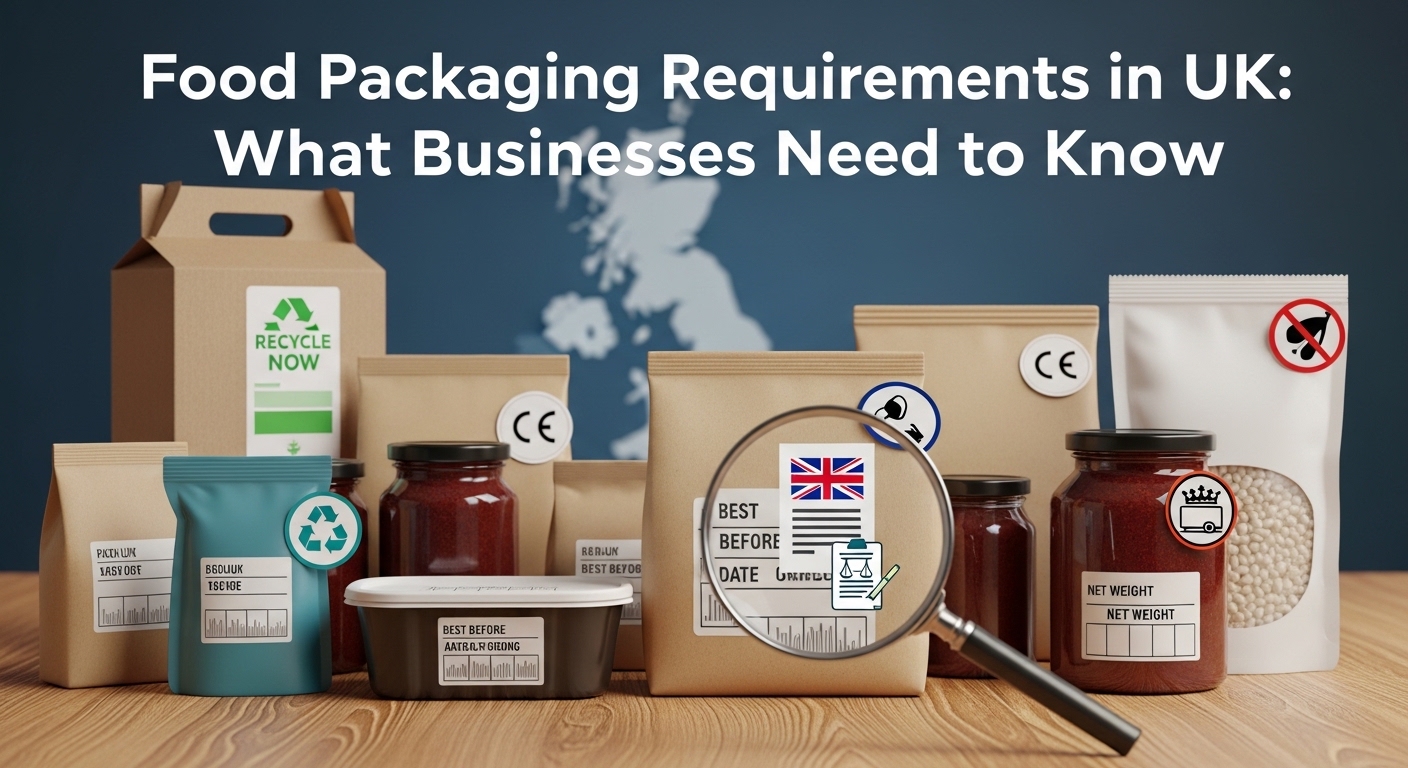
Quick answer: UK food packaging must comply with the Food Standards Agency's food-contact materials rules: packaging must not transfer harmful substances or alter the food, and it must be labelled or certified as food-safe. Since the UK Plastic Packaging Tax, packaging with under 30% recycled plastic also incurs a levy — pushing many food brands to food-grade board and paper.
If you sell food products in the UK, your packaging must comply with a complex set of regulations. Getting it wrong can result in fines, product recalls, and serious harm to your customers and your brand.
This guide covers the key legal requirements every UK food business needs to know.
Food Contact Materials (FCM) Regulations
Any packaging material that comes into direct contact with food must comply with Regulation (EC) No 1935/2004 (retained in UK law post-Brexit). This means:
- Materials must not transfer their components to food in quantities that could endanger human health
- Materials must not change the composition, taste, or odour of the food
- Packaging must be manufactured in accordance with Good Manufacturing Practice (GMP)
- A Declaration of Compliance (DoC) must be available for all food-contact materials
Food-Safe Inks and Coatings
If your food packaging is printed, the inks must be food-safe. This typically means:
- Using low-migration inks that won't transfer to the food
- Ensuring inks on the outside can't migrate through the substrate to the food-contact side
- Using water-based or UV-cured inks (not solvent-based) for food-contact surfaces
- Requesting a food safety certificate from your packaging supplier
Labelling Requirements
UK food labelling is governed by the Food Information Regulations 2014 (FIR) and must include:
Mandatory Information
- Name of the food — the legal name, not just the brand name
- Ingredients list — in descending order of weight, with allergens emphasised (bold, italic, or underlined)
- Allergen information — the 14 major allergens must be clearly highlighted
- Net quantity — weight or volume
- Date marking — "use by" for safety or "best before" for quality
- Storage conditions — how to store the product correctly
- Business name and address — the food business operator responsible
- Country of origin — required for certain products (meat, olive oil, honey, fruit, vegetables)
- Nutritional declaration — energy, fat, saturates, carbohydrate, sugars, protein, and salt per 100g/ml
Minimum Font Size
Mandatory information must be printed in a font size of at least 1.2mm (x-height). For packaging with a largest surface area less than 80cm², the minimum is 0.9mm.
Natasha's Law (Prepacked for Direct Sale)
Since October 2021, Natasha's Law requires that all food prepacked for direct sale (PPDS) must display:
- The name of the food
- A full ingredients list with the 14 allergens emphasised
This affects cafes, bakeries, delis, and any business that prepacks food on their premises for sale. Previously, these businesses could provide allergen information verbally — now it must be on the label.
The 14 Major Allergens
These must always be emphasised in the ingredients list:
- Celery
- Cereals containing gluten (wheat, rye, barley, oats)
- Crustaceans
- Eggs
- Fish
- Lupin
- Milk
- Molluscs
- Mustard
- Tree nuts (almonds, hazelnuts, walnuts, cashews, pecans, brazils, pistachios, macadamia)
- Peanuts
- Sesame
- Soya
- Sulphur dioxide and sulphites (above 10mg/kg or 10mg/litre)
Packaging Material Considerations
- Grease resistance — food packaging often needs a grease-proof barrier (especially for baked goods, fried foods, and confectionery)
- Moisture barriers — some foods require packaging that prevents moisture ingress or egress
- Temperature tolerance — frozen food packaging must withstand freezer conditions without cracking or delaminating
- Microwave safe — if the food is intended to be reheated in its packaging
- Tamper evidence — certain products must have packaging that shows if it has been opened
Recycling Symbols and Claims
If you make environmental claims on your packaging, they must be truthful and not misleading under the Green Claims Code. Use recognised recycling symbols:
- OPRL (On-Pack Recycling Label) — the most recognised system in the UK, indicating whether packaging is widely recycled, check locally, or not yet recycled
- FSC logo — only if your material is genuinely FSC-certified
- Mobius loop — indicates the material is capable of being recycled (not that it will be)
Getting Compliant Packaging
At QPack, we supply food-grade packaging with full compliance documentation. All our food-contact materials come with Declarations of Compliance, and we use food-safe inks as standard. Contact us to discuss your food packaging requirements.
Compliant Food Packaging From QPack
QPack supplies food-grade boxes with food-safe coatings for bakeries, chocolatiers and food brands, plus fully compliant ingredient and allergen labels. Get a free quote — we'll confirm food-contact suitability for your product.