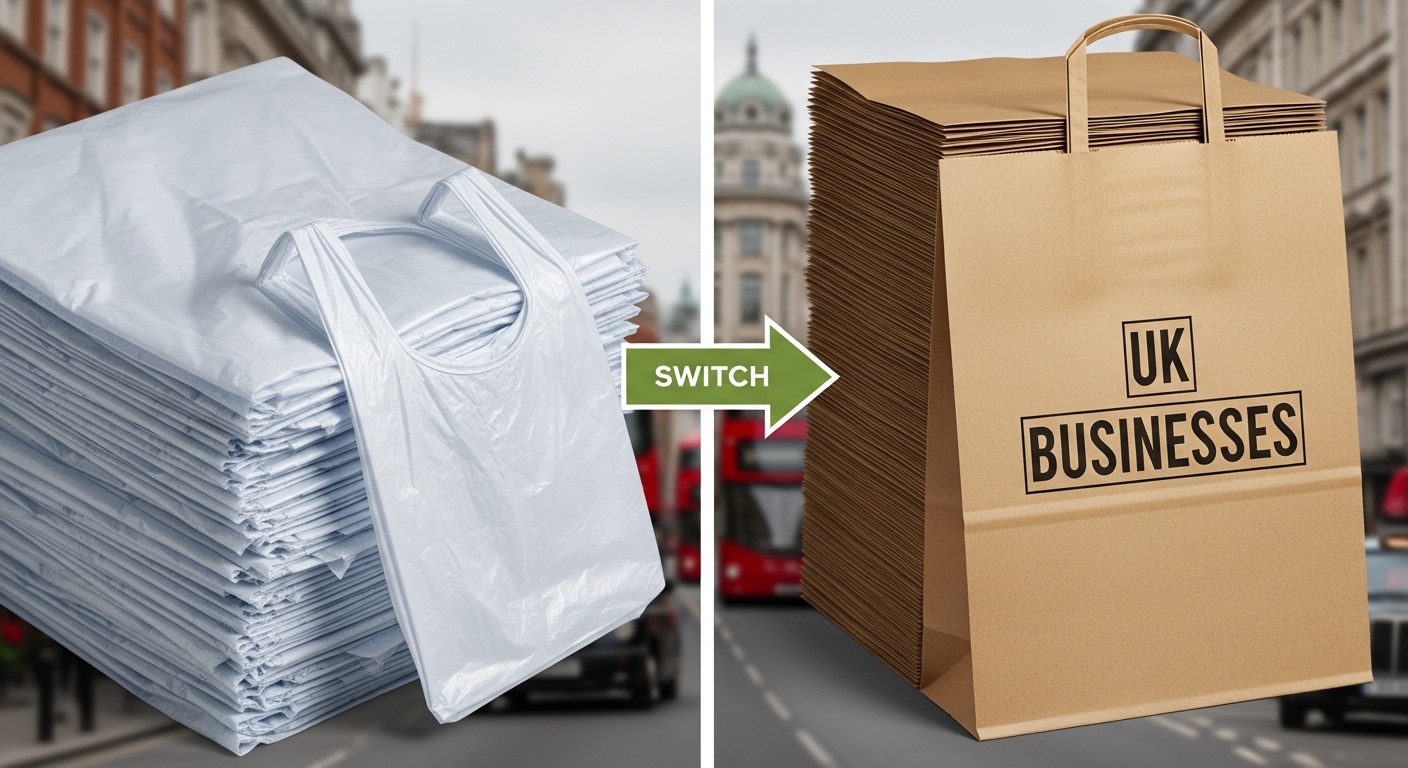
Paper Bags vs Plastic Bags: Why UK Businesses Are Making the Switch
If you run a shop, café, salon, or any business that hands products to customers, you've probably had the "which bag?" conversation more than once. It's not just a packaging decision anymore — it's a brand decision, a cost decision, and increasingly, a legal one.
Across the UK, more businesses are ditching plastic in favour of paper bags. Some are doing it because they have to. Others are doing it because customers expect it. Most are doing it for a mix of both. Here's a clear, honest look at why the switch is happening, what it actually costs, and how to make the change without disrupting your business.
The Short Answer
Paper bags are winning out over plastic for UK businesses because they're biodegradable, easier to recycle, cheaper to source responsibly at scale, and they align with tightening UK regulations and shifting customer expectations. Plastic bags still have their place, but the trend — legally, environmentally, and commercially — is moving firmly toward paper.
Now let's break down why.
1. UK Regulation Has Been Tightening for Years
This isn't a new trend — it's been building since 2015, when England introduced the 5p charge on single-use plastic bags. Since then, the direction of travel has been consistent:
- The plastic bag charge was raised to 10p and extended to all retailers, not just large ones.
- Single-use plastic carrier bags were banned outright in England from October 2023, meaning many retailers can no longer offer them at all, even for a fee.
- Scotland, Wales, and Northern Ireland have run parallel bans and charges, often ahead of England's timeline.
- Wider restrictions on single-use plastics — cutlery, plates, certain polystyrene containers — have been rolled out alongside the bag rules.
For businesses, this means plastic bags aren't just unfashionable — in many cases they're simply not a legal option anymore. Paper bags have stepped in as the practical, compliant alternative that doesn't require a total rethink of how you package goods at the till.
2. Customers Are Actively Choosing Businesses That Ditch Plastic
UK consumers have become far more environmentally literate over the past decade, partly thanks to high-profile documentaries and media coverage on ocean plastic pollution. That awareness translates directly into buying behaviour.
Customers now:
- Notice and remember what a business packages its products in
- Associate paper packaging with quality, care, and environmental responsibility
- Are more likely to shop again with a brand whose values visibly match their own
- Share and photograph packaging on social media, meaning your bag is sometimes doing marketing for you
For independent retailers, cafés, and boutiques especially, a branded paper bag has become part of the customer experience — something plastic never really achieved.
3. Paper Bags Are Genuinely Better for the Environment
It's worth being accurate here rather than just repeating marketing lines, because the environmental case for paper is strong but not absolute.
Where paper wins clearly:
- It's biodegradable and breaks down naturally within weeks to months, rather than persisting for centuries like plastic
- It doesn't fragment into microplastics that enter waterways, soil, and the food chain
- It's widely recyclable through standard UK kerbside collection, unlike many plastic bags which most councils can't process
- It can be made from recycled paper stock, reducing raw material demand
- It doesn't rely on fossil fuel feedstocks the way conventional plastic does
Where it's more nuanced:
- Producing paper bags can use more energy and water per unit than producing plastic ones
- A paper bag typically needs to be reused a handful of times to fully offset its higher production footprint compared to a single-use plastic bag
The practical takeaway for most UK businesses is this: paper solves the plastic pollution and end-of-life problem far better, and if you're already required to move away from single-use plastic, paper is the most workable, familiar, and customer-friendly alternative available.
4. The Cost Picture Isn't as Bad as Businesses Expect
Paper bags do typically cost more per unit than basic plastic ones — often somewhere in the range of a few pence more, depending on size, thickness, and whether they're printed or plain. But the full cost comparison looks different once you factor in:
- No plastic bag levy administration — since you're not charging and processing a bag charge in the same way, there's less friction at the till
- Reduced risk of non-compliance fines tied to plastic restrictions
- Bulk buying discounts — paper bag prices drop significantly at scale, and many UK wholesalers now specialise in them
- Marketing value — a printed paper bag with your logo functions as free advertising every time a customer carries it down the high street
- Customer retention — repeat business driven by brand perception can outweigh a fraction-of-a-penny difference in packaging cost
For most small and medium UK businesses, the switch pays for itself once you account for brand perception and repeat custom, not just the unit price.
5. Practical Differences Businesses Should Know About
Before switching entirely, it's worth understanding where paper bags behave differently to plastic, so you can choose the right product rather than a poor substitute.
| Factor | Plastic Bags | Paper Bags |
|---|---|---|
| Water resistance | High | Low, unless specially coated |
| Weight capacity | Very high (thin plastic can still hold a lot) | Good, but varies by GSM/thickness |
| Cost per unit | Usually lower | Usually slightly higher |
| Recyclability in UK kerbside | Often not accepted | Widely accepted |
| Biodegradability | Very slow (decades to centuries) | Fast (weeks to months) |
| Customer perception | Increasingly negative | Increasingly positive |
| Branding potential | Possible but less premium-feeling | High — seen as a premium, giftable option |
| Legal status (England, 2025) | Banned for most single-use retail purposes | Widely permitted |
If your business regularly handles wet goods, frozen items, or very heavy loads, it's worth choosing reinforced or laminated paper bags, or twisted-handle kraft bags rated for higher weights, rather than assuming a standard paper bag will perform identically to plastic.
6. How to Make the Switch Without Disrupting Your Business?
Switching packaging doesn't need to be a big, risky overhaul. Most UK businesses manage it in a few straightforward steps:
- Audit your current bag usage — sizes, quantities, and how they're used (carry-out, gift packaging, deliveries) so you order the right paper equivalents.
- Choose the right weight and finish — kraft paper bags come in different thicknesses (GSM), with options for flat handles, twisted handles, or no handles depending on use case.
- Consider branding — even a simple one-colour logo print turns a functional bag into a marketing tool.
- Source from UK or reputable suppliers — check for FSC (Forest Stewardship Council) certification to ensure the paper comes from responsibly managed forests.
- Communicate the change to customers — a small sign or till message explaining the switch reinforces the positive brand association rather than letting it pass unnoticed.
- Reassess after a trial period — track cost, customer feedback, and any operational issues (like bags struggling with wet products) before committing to large bulk orders.
Is Paper Always the Right Choice?
Not universally. A few scenarios where plastic (or a plastic alternative like compostable film) may still make more sense:
- Businesses handling raw, wet, or frozen food that needs a moisture barrier
- Situations requiring reusable, heavy-duty carrying capacity, where a thick reusable plastic bag-for-life may outperform paper
- Very cost-sensitive, high-volume operations where even small per-unit increases add up significantly
In these cases, many UK businesses use a hybrid approach: paper for general retail and branding purposes, and a compliant heavy-duty or reusable alternative for specific product types.
The Bottom Line
The shift from plastic to paper bags among UK businesses isn't a passing trend — it's the result of tightening legislation, genuine environmental benefits, and a customer base that increasingly judges brands by the packaging they use. While paper bags aren't a perfect, zero-impact solution, they solve the biggest problems associated with single-use plastic: persistence in the environment, poor recyclability, and negative customer perception.
For most UK businesses, especially retail, hospitality, and gift-based sectors, making the switch is now less a question of "if" and more a question of "how soon" and "which supplier."
If you're planning the transition, start small: audit what you currently use, test a paper alternative with your actual product range, and build in customer communication so the switch strengthens your brand rather than just changing your packaging bill.
Frequently Asked Questions
About Paper Bags
Are paper bags actually recyclable in the UK?
Yes, in most cases. Plain, uncoated paper bags are widely accepted in standard kerbside recycling collections across the UK. However, bags with plastic laminate coatings, foil linings, or heavy glossy finishes may not be recyclable through normal streams, so it's worth checking with your supplier if recyclability is a selling point you want to promote to customers.
Can paper bags get wet without falling apart?
Standard kraft paper bags aren't naturally water-resistant and can weaken or tear if they get wet. If you're packaging anything with moisture risk — fresh produce, bakery items, drinks, or frozen goods — look for bags with a wet-strength treatment or a food-safe coating, which are widely available from UK packaging suppliers without sacrificing recyclability.
What weight can a paper bag hold?
It depends on the paper's GSM (grams per square metre) and construction. Lightweight bags (around 70-90gsm) suit small, light items like gifts or bakery goods. Heavier kraft bags (100-150gsm+), especially twisted-handle or reinforced-bottom styles, can comfortably carry several kilograms — similar to a supermarket "bag for life."
Are paper bags more expensive than plastic long-term?
Per unit, yes, typically by a few pence. But when you factor in bulk pricing, no exposure to plastic-related fines or bans, and the marketing value of branded packaging, many UK businesses find the real-world cost gap narrows or disappears, especially at higher order volumes.
Do paper bags need to say "recyclable" or "biodegradable" on them?
It's not a legal requirement, but the UK's Green Claims Code (enforced by the Competition and Markets Authority) means any environmental claim you print on packaging must be accurate and substantiated. Avoid vague terms like "eco-friendly" without evidence — stick to specific, provable claims such as "made from 100% recycled paper" if that's true.
Can I get paper bags custom printed with my logo?
Yes, most UK wholesale paper bag suppliers offer custom printing, from simple one-colour logo stamps to full-colour branded designs. Minimum order quantities vary, but many suppliers now offer digital printing options with lower minimums for smaller businesses.
What's the difference between kraft paper and regular paper bags?
Kraft paper is made using a specific pulping process that produces a stronger, more tear-resistant sheet, which is why it's the standard choice for carrier bags. "Regular" or standard paper is generally less durable and better suited to lighter-duty uses like wrapping or lining rather than carrying weight.
About Packaging and Regulation
Is it illegal to give out plastic bags in the UK now?
As of October 2023, England banned retailers from selling single-use plastic carrier bags. This applies broadly across shops, takeaways, and other retail settings. Reusable "bags for life" in thicker plastic are still permitted in some cases, but thin single-use plastic bags are not. Scotland, Wales, and Northern Ireland have their own similar restrictions, so it's worth checking the specific rules that apply in your nation.
Does the plastic bag ban apply to all types of plastic packaging, or just carrier bags?
The most well-known rules target single-use carrier bags specifically, but the UK has separately banned or restricted other single-use plastics, including certain cutlery, plates, balloon sticks, and some polystyrene food and drink containers. It's a good idea to review your full packaging range, not just bags, against current regulations.
What packaging materials are considered acceptable alternatives to plastic?
Common compliant alternatives include paper and kraft bags, compostable plant-based films (like PLA), cardboard, and reusable thicker plastic bags sold under the "bag for life" model. The right choice depends on what you're packaging — food safety, moisture resistance, and weight all factor in.
Do small businesses have to follow the same packaging rules as large retailers?
Generally yes. The single-use plastic bag ban and related restrictions apply regardless of business size in England. There's no exemption for small or independent retailers, so it's worth checking compliance even if you only hand out a small number of bags each week.
What happens if my business is found using banned plastic packaging?
Enforcement is typically handled by local trading standards authorities, and penalties can include fines. Beyond the legal risk, non-compliance can also damage customer trust, particularly as awareness of these rules has become widespread among UK shoppers.
Are compostable plastic bags a good alternative to paper?
They can be, but with caveats. Compostable bags need specific industrial composting conditions to break down properly, and they generally won't compost in a normal home compost bin or garden waste collection. If your local waste infrastructure doesn't support industrial composting, a compostable bag may end up in landfill or general waste anyway, so paper is often the more genuinely practical option for most UK businesses.
How can I tell if a packaging supplier's environmental claims are trustworthy?
Look for recognised third-party certifications rather than taking marketing claims at face value. For paper, FSC (Forest Stewardship Council) or PEFC certification confirms responsible sourcing. For compostable materials, look for certification against European standard EN 13432. If a supplier can't point to a specific certification or standard, treat broad claims like "eco" or "green" with some caution.
Should I charge customers for paper bags the way plastic bags used to be charged?
There's no legal requirement to charge for paper bags in the way the plastic bag levy worked, since that charge specifically targeted single-use plastic. Many businesses choose to offer paper bags free or build the cost into product pricing, though some still charge a small fee, particularly for larger branded bags, as both a cost offset and a nudge toward customers bringing their own reusable bags.