Free delivery on orders over £280 across the UK
Skip to content

How to Measure a Box for Your Product

Prepare clear box dimensions before requesting a quote. Learn what to measure, how to distinguish internal and external size, and where inserts and wrapping affect the fit.

Your specification. Your artwork. A clear quotation.

How to Measure a Box for Your Product packaging example
Practical packaging guidance
Practical Guidance

Measure the item as it will be packed

Use the product with its normal cap, lid, sleeve or retail wrap in place. Measure its maximum length, width and height in millimetres. Include handles, shoulders and other parts that extend beyond the main body. For several items, arrange them as intended and measure the complete group.

Write down the approximate total weight as well. Dimensions describe the space required, but weight and shape help determine the supporting structure.

Find your fit

Explore the relevant packaging

Compare the details, then tell us what you have in mind.

Custom Boxes

Product boxes, rigid gift boxes, folding cartons, mailers and sleeves — printed with your logo, engineered to your exact dimensions, and delivered across the UK. Order from 100 units — and because setup cost is the same at any quantity, most brands find ordering 1,000 gives 10× more stock for almost the same total cost.


B2B Engineering & CAD Preparation

How to Measure a Box for Your Product: The Essential Internal Dimension Formula

Accurate packaging manufacturing relies entirely on precise internal dimensions (Length x Width x Depth). Measuring only the external dimensions of an existing carton will result in a box that is too small for your product due to board thickness and corner radius allowances.

01 Work through your brief 4 Standards
01
State internal or external dimensions

Internal dimensions describe the usable space inside a box. External dimensions describe the outside of the finished pack. Board thickness, folds, closures and construction mean these are not interchangeable. Always label which measurement you are giving. If you are quoting an existing box, measure it assembled and explain how you measured it. If a maximum outer size is important for a shelf, storage bin or delivery service, state that as a separate constraint.

02
Allow for everything around the item

Tissue, honeycomb wrap, dividers and fitted inserts take up space. An insert may need folded walls or a support base that cannot be represented by the product dimensions alone. List those components before the box size is finalised. There is no single clearance that suits every item and construction. The pack should allow practical loading and removal without leaving the contents free to move excessively. Discuss the tolerance with the proposed structure and use a sample or packing trial where needed.

03
Use an agreed dimension order

Write the dimensions with labels, for example length 200 mm, width 150 mm, depth 80 mm. This avoids ambiguity when a supplier or designer uses a different convention. Add a simple sketch showing the lid opening and the orientation of the product. For a bag, record width, height and gusset separately. For a flat sheet or label, give width and length and describe any shaped outline. For honeycomb wrap, specify whether the measurement is flat or expanded.

04
Check the complete dispatch pack

Once assembled, measure the outside of the finished shipping pack and weigh it with all contents, labels and protective material. Compare those measurements with the current requirements of the delivery service you plan to use. Do not assume an empty box name establishes its postal category. Keep the approved dimensions and drawing with the artwork. A later change in board, insert or product can alter the fit, so review the specification when those details change.

02 L x W x D Rule Dimension Formula
  • Core Standard: Always measure in the exact order: Length (longest side of opening) x Width (shorter side of opening) x Depth (vertical height from base to top rim).
03 Fitment & Finger Allowances Clearance Tolerances
  • Core Standard: Add 3mm to 5mm clearance around your primary product to allow easy insertion, wrapping tissue, or protective bubble lining without excessive internal rattle.
04 Microns vs Corrugated Calibres Board Thickness

Remember that E-flute adds ~1.5mm per wall, B-flute adds ~3.0mm, and rigid greyboard adds 2mm to 3mm.

  • Key Detail: External dimensions are always larger than internal usable space.
05 Pre-Production Sample Fit CAD Dielines
  • Core Standard: Always test physical prototypes or 3D CAD dielines before authorizing volume print runs, especially when integrating custom foam or card inserts.
How to Measure a Box for Your Product Bespoke UK Production

Key Standards At A Glance

  • 100% Quality Checked Prior to Dispatch
  • Free 3D Digital Simulation & Dieline
  • Certified Food-Safe & FSC Materials
  • Tracked Mainland UK Delivery Included
HOW IT WORKS

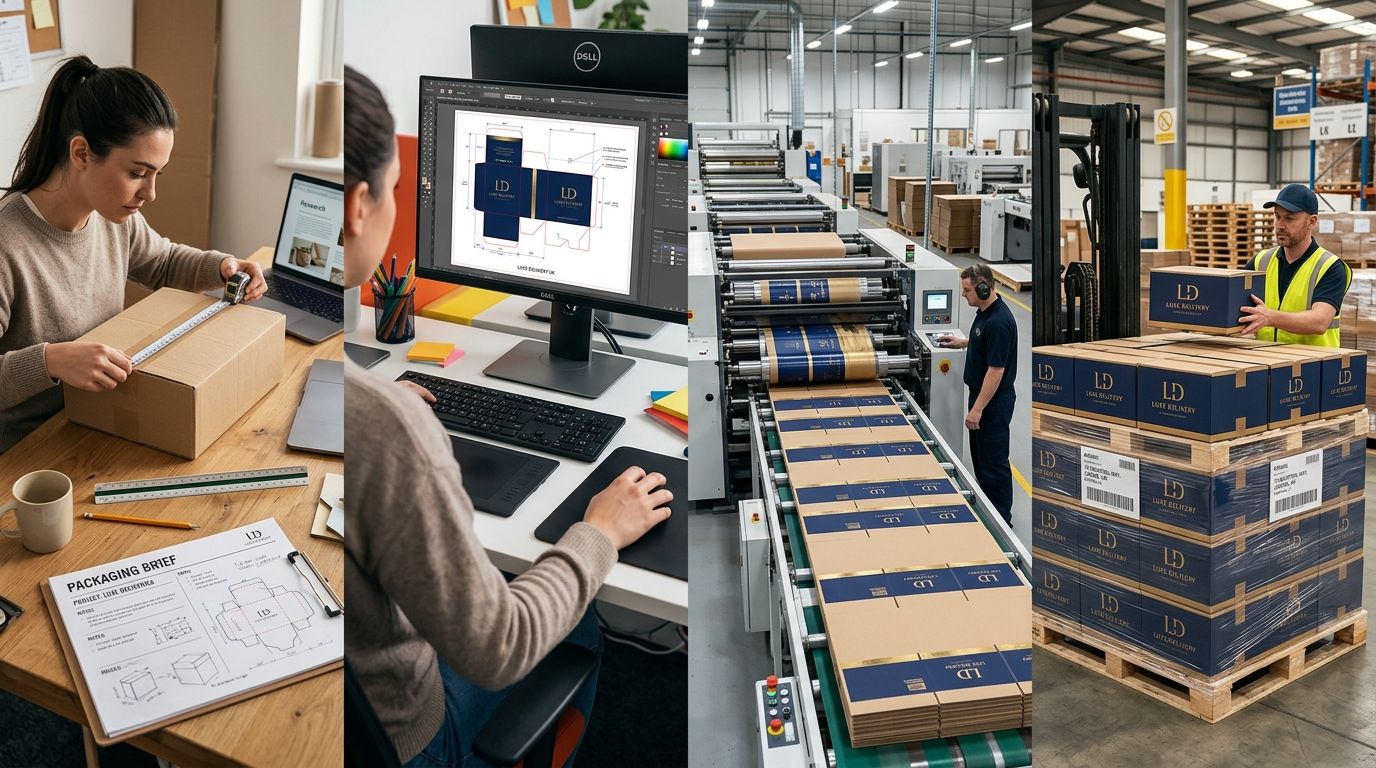
Our 4-Step Packaging & Production Process

From initial idea to your doorstep, here is how easy it is to order custom packaging with QPack.

01 TELL US YOUR SPECS

Tell Us What You're Packing

Tell us your product size and quantity. We give you the exact box dimensions and a free template for your design.

02 FREE 3D PROOF

Free 3D Artwork Proof

Send us your logo or artwork. We create an interactive 3D digital model so you can check your box before printing.

03 VIBRANT PRINT

High-Definition Printing

Your boxes are printed in vibrant color and pre-creased so they fold up quickly with crisp, clean corners.

04 DOORSTEP DELIVERY

Quality Check & Fast Delivery

Every batch is inspected for quality, packed flat to save your storage space, and shipped tracked to your door.

Clear Answers

Frequently Asked Questions

Clear answers on sizing, minimum order runs, artwork proofs, board calipers, and free tracked UK delivery.

Why must packaging always be specified using internal dimensions?

Internal dimensions represent the usable cavity where your product sits. Because paperboard and corrugated flutes have physical wall thickness (1.5mm to 4mm), quoting external dimensions causes cartons to be manufactured too tight.

What is the standard clearance allowance for ecommerce shipping mailers?

For products wrapped in tissue or void fill, we recommend adding 5mm to 10mm to each internal axis (Length, Width, Depth) to ensure comfortable packing and effortless unboxing for the customer.

How do inserts affect internal dimension requirements?

When incorporating custom foam or cardboard inserts, the internal depth must account for both the product height and the floor/ceiling cushion thickness (typically 10mm to 20mm per side).

Have a specific requirement or custom dieline?

Our UK packaging specialists can verify bottle clearances, create tailored structural CAD dielines, and supply physical plain samples.

Speak with our packaging specialists

Let’s make it yours

Turn your brief into a quotation.

Tell us what you are packing, your dimensions and quantity. We will help you work through the specification.

Try in 3D Live Studio →Start my quote