
Skip to content

Custom specifications · Personal quotation

Custom Printed Roll LabelsLabels that fit your packing routine.

Request printed labels on rolls for hand application or a compatible labelling machine. Confirm the label, adhesive and roll configuration together before production.

Your specification. Your artwork. A clear quotation.

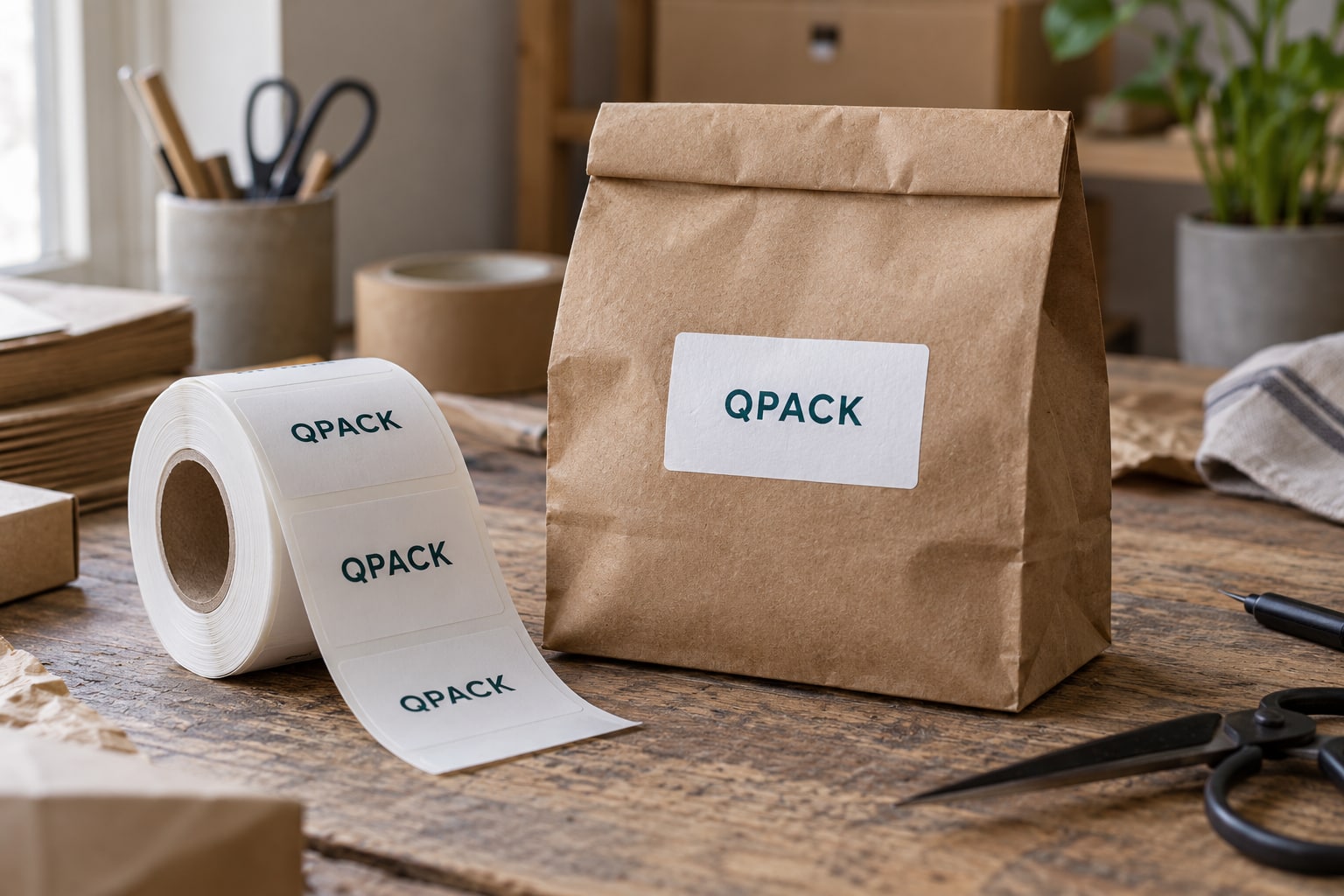
Custom Printed Roll Labels packaging example
Illustrative label concept; roll configuration is agreed separately

Consider the details

The roll matters as much as the label.

A roll label quotation needs more than the finished sticker size. Core diameter, maximum roll diameter, winding direction and the gap between labels can affect whether a roll works on your equipment. For hand application, a convenient roll size and easy peeling may be the more useful priorities.

Tell us what you label, how you apply it and the conditions it will face. We will discuss a paper or film construction, finish and adhesive alongside the roll configuration.

A closer look

Details worth deciding early

01

Share the application method

If you use a machine, provide its label specification or the requirements from its supplier. Include the core size, maximum outside diameter, web width and required presentation direction. A photograph of an existing roll can help, but written specifications reduce the chance of confusing unwind orientations.

For hand application, think about how the roll will sit at the packing bench and whether operators need a dispenser. The most economical roll size is not always the easiest one to handle in a small workspace.

02

Define the surface and conditions

Glass, coated cardboard and different plastics can behave differently with the same adhesive. Describe the surface, whether it is curved and whether it is clean and dry when the label is applied. Add any refrigeration, condensation, moisture or outdoor exposure.

Do not choose a film label on the assumption that every part of the construction is waterproof. The face material, adhesive, ink and finish all need to suit the intended conditions. Test the proposed label on the actual product.

03

Keep artwork versions organised

If you have several scents, flavours or product sizes, list every version and its quantity. Make sure the artwork filename and product name match. Variable information, barcodes or batch spaces may need separate consideration from the main design.

Small text and fine lines should remain readable at the finished size. Leave the specified clearance around the cutting line and follow the agreed artwork template. Approve the proof for every version, not just the first one.

04

Confirm how labels are counted and packed

Ask for the approximate labels per roll, the number of rolls and any allowed variation to be stated in the quote. That makes it easier to plan stock and distribute rolls across workstations. If the roll must fit a particular holder or machine, treat the physical limit as part of the specification.

Keep unused labels in the conditions recommended for the chosen material. Heat, damp or prolonged storage can affect some constructions. Ask about the proposed stock’s storage guidance if you buy enough for several months.

05

Describe winding direction with a diagram

The words left, right, inside and outside can mean different things when two people are looking at a roll from different positions. For machine application, use the orientation diagram supplied by the equipment manufacturer and identify the required direction on that diagram. Include whether the print faces inward or outward and which edge of the label leaves the roll first.

Keep the diagram with the approved print specification. If a different machine is introduced later, check its requirements before reordering the same roll. A roll that feeds correctly on one setup may not suit another even when the label size is unchanged.

Hand-applied rolls are usually less constrained by a machine specification, but winding direction can still affect convenience. Think about the way the operator holds the container and peels the label. A simple trial is useful when the label has a clear top and bottom or is applied in a tight working area.

06

Separate the label size from the web size

The finished label is only part of the material passing through a machine. The backing liner, gaps and margins also occupy space. Give your equipment’s requirements for the complete web as well as the finished label dimensions. If labels are arranged more than one across, make that arrangement explicit.

The liner needs to release the label appropriately for the intended application method. Ask for the proposed combination to be confirmed rather than choosing a face material in isolation. If your current rolls work reliably, retain their supplier specification and a sample as references.

For shaped labels, consider how the design will be cut and handled. Very narrow points, fine projections or unusual outlines may need review before production. Share the cut shape separately from the printed artwork so the quoted outline is unambiguous.

07

Leave space for information added later

Some products need a batch number, date or other information added after the main label is printed. Tell us how you intend to add that information: handwriting, a separate label, a stamp or a particular printing system. The surface and coating need to suit that method.

Mark the variable-information area clearly in the artwork and keep it free of a finish that could interfere with the next step. If a machine prints onto the label, provide its requirements and test the proposed stock before committing to a full run.

Keep the fixed and variable information distinct during proof approval. Check that the preprinted wording is correct and that the blank space is large enough for the longest likely value. A date or batch field that only fits the example used in the design can become difficult to use later.

08

Build a useful approval checklist

Review the finished size, cut shape, material, adhesive and roll details together. Then check every artwork version for spelling, colours, barcode numbers and required copy. A proof should identify the version being approved so there is no ambiguity between similar products.

Where appearance or performance is important, discuss a physical sample or material trial appropriate to the job. A digital proof is valuable for layout, but it does not prove adhesive performance, roll feeding or the appearance of a finish in real lighting.

Keep a reference from the first approved production run. When ordering again, compare the specification rather than relying on a short description such as the usual labels. If the application surface, artwork or equipment has changed, mention it even when the label dimensions remain the same.

From your brief to the finished result.

  1. 01

    Share your brief

    Send your dimensions, quantity and artwork, or explain what you need help choosing.

  2. 02

    Review the specification

    Confirm the material, construction, proof, price and delivery arrangements before placing your order.

  3. 03

    Prepare for delivery

    Keep a copy of the agreed specification so that future orders are easy to compare and repeat.

Useful answers

Before you choose.

Ask us a question ↗
What roll details do you need?

For machine use, provide core size, maximum roll diameter, web width and unwind direction. For hand use, tell us how you will dispense and apply the labels.

Can I have several designs?

Yes, include each artwork version and its quantity so the production arrangement can be quoted clearly.

Can roll labels be supplied for bottles?

Yes. Describe the bottle surface, curvature and conditions of use, then test the proposed construction on the actual container.

Let’s make it yours

Tell us what you are planning.

Your size, quantity and intended use give us a useful starting point. Artwork is welcome, but it can follow later.

Start my quote
WhatsApp Us

QPACK · YOUR NEXT PROJECT

Let’s shape your packaging.

Share what you know. We will help with the details.

  1. 01 Your packaging
  2. 02 Your details
Your packaging

Options describe your preferences. We will confirm the material, availability, price and timing in your quotation.

Your contact details

We use these details to respond to your enquiry. Read our privacy policy. No payment is taken.